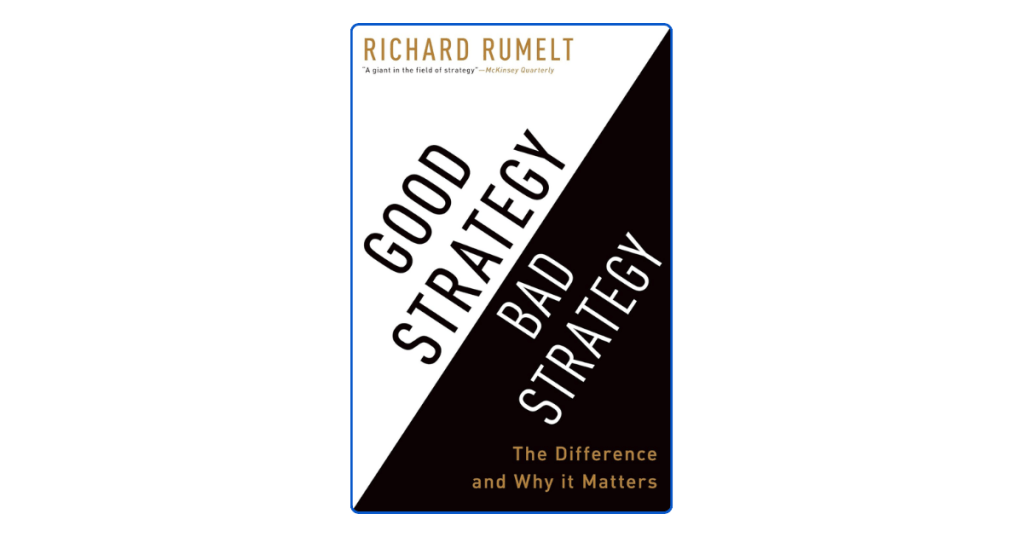
In Good Strategy Bad Strategy, renowned strategist Richard P. Rumelt shatters the illusion that vision statements and goals are strategy. With clarity and intellectual firepower, Rumelt reveals what real strategy looks like and why most leaders get it painfully wrong.
This isn’t a book about buzzwords or broad declarations. It’s a field guide for navigating uncertainty, diagnosing core challenges, and crafting focused action plans that actually move the needle. Rumelt draws on decades of academic research, military doctrine, and high-level business consulting to expose the gap between good strategy (focused, coherent, and grounded in real advantage) and bad strategy (fluff, slogans, and wishful thinking).
Whether you’re leading a Fortune 500 company or launching a startup, this book teaches one crucial lesson: Real strategy is about making hard choices and avoiding the trap of saying everything matters.
Top 10 Key Lessons from Good Strategy Bad Strategy
1. A Goal Is Not a Strategy
Setting ambitious targets doesn’t count as strategy. Real strategy identifies the challenge, defines a guiding policy, and lays out coherent action steps. Vision without execution is just noise.
2. Diagnose Before You Decide
Great strategies begin with clear diagnosis. Understand the root problem not just the symptoms before attempting to solve anything. Without this, you’re guessing.
3. The Kernel of Good Strategy: Diagnosis, Guiding Policy, Coherent Actions
Rumelt’s strategy “kernel” has three parts: a deep diagnosis, a guiding policy (the game plan), and a set of coherent actions. Miss any part, and you don’t have strategy you have fluff.
4. Bad Strategy Is Everywhere and It’s Dangerous
Bad strategy thrives in vague language, unrealistic ambition, and failure to face reality. It’s seductive because it sounds impressive, but it leads to confusion, inaction, and failure.
5. Leverage is Key to Momentum
Good strategy finds points of leverage places where effort yields outsized impact. Instead of trying to do erything, it identifies where pressure applied can shift the whole system.
6. Avoid the “Template-Style” Strategy Trap
Many companies copy strategic formats and fill them with empty jargon. Real strategy is context-specific, brutally honest, and built from deep thinking not fill-in-the-blank frameworks.
7. Strategy Is About Focus, Not Lists
A laundry list of initiatives is not a strategy. Focus means concentrating resources on a few high-impact moves that align with your core advantage and market reality.
8. Adaptation Requires Courage and Honesty
Strategy demands hard choices and confronting inconvenient truths. Leaders must be willing to break from legacy thinking and adjust when conditions shift.
9. Competitive Advantage Is the Foundation
Every good strategy builds on a form of advantage whether in capabilities, positioning, resources, or insight. Without an edge, even the most elegant plan falls flat.
10. Good Strategy Aligns Action with Insight
Execution isn’t an afterthought it’s the strategy in motion. All actions must stem from the guiding policy and reinforce one another to achieve compound effect.
Good Strategy Bad Strategy is a masterclass in clear thinking, ruthless prioritization, and smart execution. It teaches that strategy isn’t about saying yes to everything it’s about saying no to almost everything, and yes to what matters most.
Disclosure: This post includes affiliate links that may earn me a commission at no cost to you if you make a purchase.
can explore the book here:
Blinkist: Best Book Summaries & Audio Book Guides
![nick [Alliedify] Avatar](https://0.gravatar.com/avatar/6955a6009ff9c6a76e2eb88c263c9426c8c386b0a7637b4d0cc051871ee8c9f3?s=40&d=identicon&r=G)
 Alliedify
Leave a comment