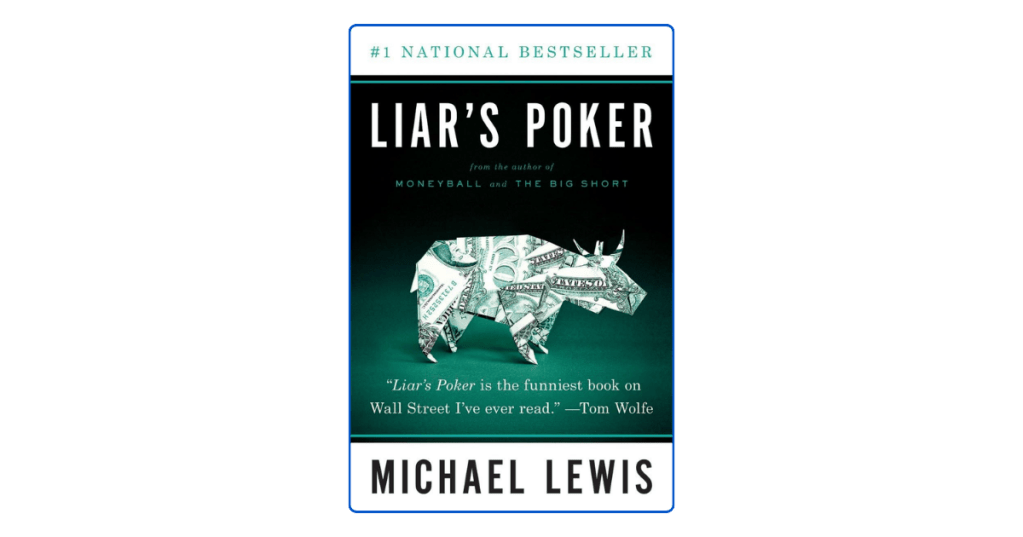
In Liar’s Poker, bestselling author and former bond salesman Michael Lewis pulls back the curtain on the cutthroat world of Wall Street in the 1980s an era defined by greed, egos, and financial engineering run amok. The book is part memoir, part exposé, chronicling Lewis’s time at Salomon Brothers, one of the most influential (and chaotic) investment banks of its time.
Through sharp wit and first-hand accounts, Lewis reveals how a new breed of traders rose to power not through traditional finance expertise, but through bravado, instinct, and a willingness to gamble big with other people’s money. The title Liar’s Poker refers to a high-stakes bluffing game played with dollar bills a perfect metaphor for the speculative frenzy gripping the financial industry during this period.
More than just a story of Wall Street excess, Liar’s Poker is a cautionary tale about the cultural values that shaped the financial sector and the systemic risks those values create. It’s a must-read for anyone seeking to understand the roots of modern finance, the psychology of traders, and why markets often act irrationally.
Top 10 Key Lessons from Liar’s Poker
1. The Financial World Rewards Risk-Takers Not Rule-Followers
Wall Street in the ’80s didn’t value ethics or prudence it valued bold bets and quick wins. Success often depended more on guts than on financial expertise.
2. Culture Eats Strategy in Investment Banking
Salomon Brothers was driven more by its internal culture of ego, competition, and dominance than by long-term strategy. Toxic culture can shape and often distort behavior at scale.
3. Information Asymmetry Is a Weapon
Traders who understood how mortgage-backed securities worked gained a massive edge over clients who didn’t. Knowledge gaps create opportunities for manipulation and profit.
4. The Market Is Not Always Rational
Many financial products sold in the 1980s had little real-world value. They were driven by sales tactics and hype, not fundamentals proving that markets are often driven by emotion, not logic.
5. Greed Isn’t Just a Vice It’s a Systemic Risk
The unregulated hunger for profit created the conditions for instability. Liar’s Poker shows how unchecked greed can infect an entire industry and set the stage for future crashes.
6. Financial Innovation Can Be Dangerous
The rise of mortgage bonds and derivatives created new ways to make money but also new layers of complexity and risk that even the bankers didn’t fully understand.
7. The Best Salespeople Don’t Just Sell They Manipulate
In high finance, salesmanship often becomes psychological warfare. Success hinges on the ability to project confidence, bluff convincingly, and close deals at any cost.
8. Naivety Gets Punished in High-Stakes Environments
New recruits were often thrown into the deep end with little training. Survival depended on quick learning, street smarts, and a thick skin not academic credentials.
9. Wealth Doesn’t Equal Wisdom
Many of the highest-paid traders and executives made decisions based on impulse, arrogance, or office politic not thoughtful analysis. Financial success often masks ignorance.
10. History Repeats When Lessons Are Ignored
The excesses documented in Liar’s Poker foreshadow the 2008 financial crisis. When short-term profits override long-term responsibility, the entire system becomes vulnerable.
Liar’s Poker isn’t just a book about finance it’s a snapshot of power, hubris, and human nature at its most unfiltered. It warns us that when money becomes the only scoreboard, the game stops being fair and starts being dangerous.
Disclosure: This post includes affiliate links that may earn me a commission at no cost to you if you make a purchase.
can explore the book here:
Blinkist: Best Book Summaries & Audio Book Guides
![nick [Alliedify] Avatar](https://0.gravatar.com/avatar/6955a6009ff9c6a76e2eb88c263c9426c8c386b0a7637b4d0cc051871ee8c9f3?s=40&d=identicon&r=G)
 Alliedify
Leave a comment