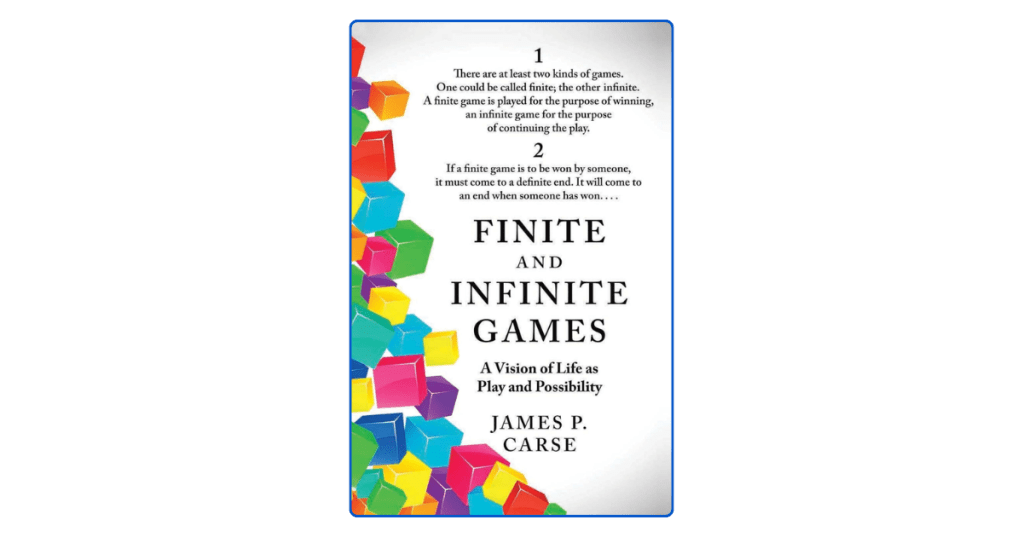
Introduction – Two Ways to Play the Game of Life
In Finite and Infinite Games, James P. Carse delivers a profound yet deceptively simple framework for understanding life, work, and human relationships. His central idea is that all human endeavors fall into two categories: finite games, which are played to win, and infinite games, which are played to keep the game going.
Finite games like sports, elections, or business deals have clear rules, a set duration, and winners and losers. Infinite games like learning, love, and culture have no fixed endpoint; their goal is continual growth, evolution, and renewal.
Carse’s work challenges readers to think beyond short-term victories and embrace a mindset that values curiosity, adaptability, and long-term vision. This is not just philosophy it’s a playbook for leaders, creators, and anyone who wants to live with deeper purpose.
Top 10 Lessons from Finite and Infinite Games
1. Life Offers Two Kinds of Games
Finite games aim for a definitive conclusion; infinite games aim for endless continuation. Knowing which game you’re playing changes everything.
2. Winning Isn’t Always the Goal
In an infinite game, success isn’t about defeating others it’s about sustaining momentum, learning, and evolving.
3. Rules Are Flexible in Infinite Games
Finite games have fixed rules; infinite games allow them to shift as players adapt and new possibilities emerge.
4. Time is Measured Differently
Finite games are bound by clock time. Infinite games unfold in “generational time,” where the horizon keeps moving forward.
5. Players vs. Actors
In finite games, you act within a defined role. In infinite games, you play as an authentic self, not just a part in a script.
6. Competition vs. Contribution
Finite games are competitive; infinite games are collaborative, aiming to expand the play for everyone involved.
7. Leadership is About Longevity
True leadership means keeping the game alive for others, not just securing your own position.
8. Possibility Over Prediction
Infinite thinkers focus on possibilities, while finite thinkers fixate on predictable outcomes.
9. Freedom is Found in Play
In infinite games, play is creative, adaptive, and free from rigid structuresmaking it the purest form of human expression.
10. Choose the Infinite Mindset in Key Areas of Life
Approach relationships, creativity, and personal growth as infinite games, and you’ll create a life that continues to expand in meaning and potential.
Disclosure: This post includes affiliate links that may earn me a commission at no cost to you if you make a purchase.
can explore the book here:
Blinkist: Best Book Summaries & Audio Book Guides
Why This Book Matters
Carse’s philosophy reframes success not as a finish line to cross but as a game to keep playing. For entrepreneurs, leaders, and creatives, this shift can transform decision-making, relationships, and how you measure achievement.
Final Take:
“In the finite game, you chase a trophy. In the infinite game, you shape a legacy.”
![nick [Alliedify] Avatar](https://0.gravatar.com/avatar/6955a6009ff9c6a76e2eb88c263c9426c8c386b0a7637b4d0cc051871ee8c9f3?s=40&d=identicon&r=G)
 Alliedify
Leave a comment