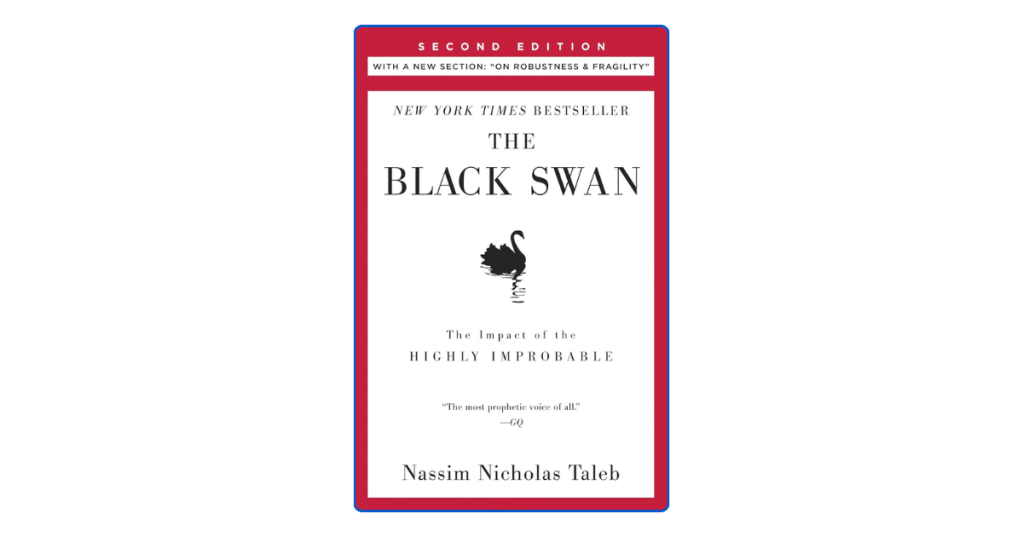
By Nassim Nicholas Taleb
In a world obsessed with prediction, The Black Swan is a powerful reminder of everything we don’t see coming and why it matters more than we think.
Nassim Nicholas Taleb, a former trader turned philosopher-mathematician, argues that the most significant events in history from market crashes to technological breakthroughs are “Black Swan” events: rare, unpredictable, and game-changing. These events lie outside the realm of regular expectations, and yet, after they occur, we act as if we saw them coming all along.
Drawing from philosophy, statistics, and his own experience in financial markets, Taleb dismantles the illusion of control and challenges our dependence on models, forecasts, and false certainty. Instead, he urges us to embrace uncertainty and design systems that are resilient not just efficient.
In a noisy world of overconfidence, The Black Swan is a masterclass in humility, skepticism, and strategic thinking. It’s not just a book it’s a survival guide for anyone operating in a volatile, fast-changing world.
Top 10 Key Lessons from The Black Swan
1. Rare Events Drive History Not the Predictable Ones
Most of what shapes the world major discoveries, financial crashes, revolutions is the result of rare, unexpected events. Yet we build systems assuming the opposite.
2. We’re Wired to Fit Stories to Randomness
Humans hate uncertainty. So we create neat narratives to explain the past even when the truth is more random and chaotic than we care to admit.
3. Beware of the “Expert Illusion”
Experts often project confidence, but their track records in forecasting complex systems (like markets or politics) are often worse than chance. Confidence is accuracy.
4. Black Swans Are Obvious After They Happen
Hindsight bias makes us believe events were predictable all along. This distorts how we prepare for future risk and leads us to underestimate the unknown.
5. We Overvalue What We Can Measure
Quantitative models give us comfort but they often ignore rare events or assume normal distributions. What’s not in the data can be more dangerous than what is.
6. Don’t Try to Predict Build Robustness Instead
Rather than trying to forecast rare events, focus on building systems that can survive or even benefit from shocks. Resilience beats precision.
7. Scalable Professions Amplify Black Swans
In fields like tech, finance, or publishing, a few people dominate while most struggle. These “winner-takes-all” markets are fertile ground for Black Swans both good and bad.
8. The Past Doesn’t Always Prepare You for the Future
Relying solely on historical data creates blind spots. Just because something hasn’t happened yet doesn’t mean it won’t prepare for the unimaginable.
9. Asymmetry Can Be Powerful
Look for opportunities with limited downside but unlimited upside. You won’t see Black Swans coming but you can be positioned to benefit when they arrive.
Disclosure: This post includes affiliate links that may earn me a commission at no cost to you if you make a purchase.
can explore the book here:
Blinkist: Best Book Summaries & Audio Book Guides
10. Embrace “Antifragility”
Some systems don’t just survive shocks they improve because of them. Design your life, investments, and decisions to gain from volatility, not fear it.
![nick [Alliedify] Avatar](https://0.gravatar.com/avatar/6955a6009ff9c6a76e2eb88c263c9426c8c386b0a7637b4d0cc051871ee8c9f3?s=40&d=identicon&r=G)
 Alliedify
Leave a comment