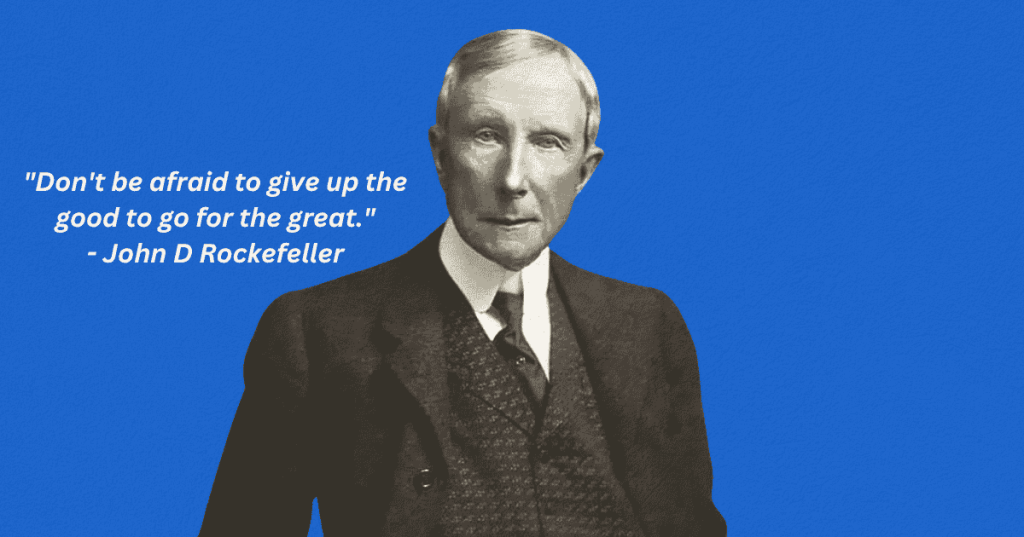
Before he became the richest man on Earth…
Before his name reshaped capitalism and triggered antitrust laws…
John D. Rockefeller was just a boy—quiet, serious, and dirt poor—walking down a dusty back road in Richford, New York.
No wealth.
No connections.
No lucky break.
What he did have was control.
While others played, he observed. While others gambled, he saved. While others moved fast, he wrote everything down—every penny, every habit, every decision.
He wasn’t waiting for the world to change. He was reprogramming himself to change it.
This is the story of how John D. Rockefeller built a mind so steady, so precise, and so unshakable that it didn’t just create wealth—it conquered chaos, broke monopolies, and rewrote the rules of business itself.
The Origin of Control
Rockefeller’s early life offered no privilege.
His family moved constantly. His father—“Big Bill”—was a con man who came and went like the wind. Loud, reckless, and unreliable.
But John D. wasn’t shaped by his father. He was shaped by contrast.
Where Big Bill bluffed, John observed. Where his father chased attention, John chased structure.
From a young age, he trained his mind like a machine.
He kept a personal ledger. He tracked every coin. He distrusted memory and ignored emotion. He found peace not in noise, but in order.
At 16, he landed his first job as a bookkeeper, working 12 hours a day for 50 cents—and walking miles home afterward.
He called it “the day of days,” celebrating the anniversary every year as his personal Independence Day.
Why?
Because it marked the day he began building freedom—not through rebellion, but through routine.
Work: His Greatest Gift
While others ran from work, Rockefeller embraced it.
He didn’t treat work as a chore. He treated it as a tool—to master his mind, to build endurance, to train restraint.
He once said, “Work is the greatest gift I ever had.”
That wasn’t motivational fluff. It was his operating system.
He wasn’t driven by greed. He was driven by optimization. He knew that mastering work meant mastering outcomes.
Even as a teenager, he thought like an investor.
He once loaned $50 to a local farmer—at 7% interest—and tracked every detail like it was a million-dollar deal.
Not because of the amount, but because of the principle:
Know where every dollar is going before you spend it.
That $50 wasn’t just a loan. It was the birth of his financial philosophy.
The Discipline of Delay
While his peers chased quick wins, Rockefeller practiced patience.
He lived below his means. He saved relentlessly. He studied cost, value, and timing like a surgeon studies anatomy.
He trained himself to enjoy saving more than spending.
To feel discomfort in waste.
To delay gratification until every move made sense.
Every decision was a long-term bet:
- “Will this matter in 5 years?”
- “Does this create value or just comfort?”
- “Is this helping me evolve—or just helping me escape?”
This wasn’t natural discipline. It was trained.
He rewired his brain to view everything as a business:
His money. His time. His emotions. His reputation.
The Stillness That Broke Men
In the boardroom, Rockefeller was unnervingly calm.
He didn’t argue. He didn’t boast. He didn’t react.
He watched.
That silence? It shattered competitors.
Because behind it was a mind calculating everything—word by word, move by move.
Where others panicked, Rockefeller paused.
Where others chased noise, he followed numbers.
Even during stock market crashes, when other men jumped from windows, Rockefeller stayed at his desk.
Reviewing ledgers.
Running models.
Finding opportunity in the ashes.
He once said, “I always tried to turn every disaster into an opportunity.”
It wasn’t luck. It was reframing.
He wasn’t fearless. He was in control.
Respect for Money, Not Worship
Even after Standard Oil started printing millions, Rockefeller treated money with the same intensity as when he made 50 cents a day.
Every barrel of oil was optimized.
Every nail used in shipping crates was reviewed.
Every ounce of waste was cut, repurposed, or recycled.
He reused metal shavings. Captured excess gas. Recycled barrels.
He wasn’t obsessed with frugality. He was obsessed with efficiency.
“We can afford to lose money—even a lot of money,” he once said.
“But we cannot afford to lose a reputation or to waste.”
That wasn’t greed talking.
That was discipline.
He cut the fat, not the future.
He bet big when the numbers justified it. But he never gambled on ego.
The Empire of Precision
Rockefeller didn’t win because he was loud.
He won because he was methodical.
He didn’t build a business. He built a system.
A system of cost control.
A system of emotional discipline.
A system of long-term thinking in a short-term world.
His control was so absolute that the government eventually had to dismantle Standard Oil.
But by then, it was too late.
The machine he built couldn’t be stopped.
His wealth grew after the breakup.
Because it wasn’t built on oil—it was built on structure.
The Real Secret of Rockefeller
So, what made Rockefeller unstoppable?
Not luck.
Not genius.
Not inheritance.
It was discipline.
It was deliberate thought.
It was a system designed to win silently.
He didn’t try to be great.
He became the kind of man success would chase.
He understood what most people ignore:
The greatest power isn’t what you control—it’s that you control yourself.
And in a world full of chaos, distraction, and ego…
That might just be the ultimate edge.
Final Thoughts: Be the Calm One
If there’s one thing to learn from John D. Rockefeller, it’s this:
Master yourself before you try to master the world.
Train your mind to ask:
- What’s the opportunity here?
- What’s the signal, not the noise?
- What helps me grow vs. what just feels good?
Stay calm when others panic.
Save when others spend.
Think long when others think fast.
Because the empires that last are not built on noise.
They’re built on structure.
On patience.
On silence.
That’s the Rockefeller way.
![nick [Alliedify] Avatar](https://0.gravatar.com/avatar/6955a6009ff9c6a76e2eb88c263c9426c8c386b0a7637b4d0cc051871ee8c9f3?s=40&d=identicon&r=G)
 Alliedify
Leave a comment