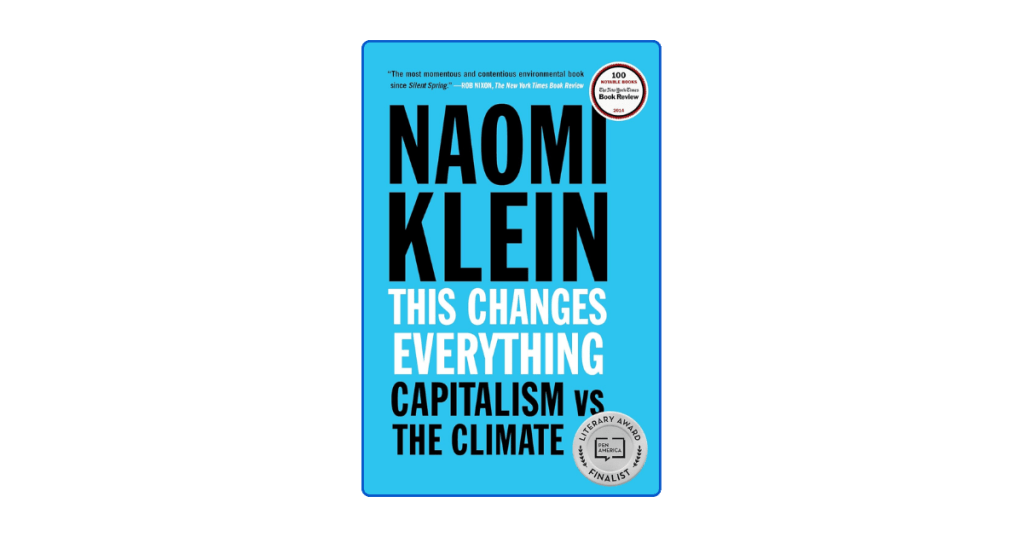
Capitalism vs. The Climate
A Wake-Up Call for Our Planet
In This Changes Everything, Naomi Klein delivers a bold and uncompromising examination of the climate crisis—arguing that it’s not just about carbon emissions or renewable energy, but about our entire economic system. Klein’s central thesis is stark: capitalism, in its current unregulated, growth-obsessed form, is fundamentally at odds with a stable climate.
Through meticulous research, investigative journalism, and on-the-ground reporting, Klein connects the dots between corporate power, political inaction, and environmental degradation. She challenges the comforting narrative that small, incremental changes will solve the climate emergency, instead calling for a deep economic and societal transformation.
This is not a doomsday book—it’s a rallying cry. Klein reframes climate action as an opportunity to build a more just, sustainable, and equitable world. Her work urges readers to stop treating climate change as a distant scientific problem and start seeing it as a present, urgent, and human crisis.
Top 10 Lessons from This Changes Everything
1. The Climate Crisis Is a System Crisis
Global warming is not just an environmental problem—it’s a symptom of an economic system built on endless extraction and consumption.
2. Free-Market Capitalism Has Limits
Unregulated markets and relentless pursuit of profit often undermine the collective action needed to address climate change.
3. Incrementalism Won’t Work
Minor tweaks—like lightbulb changes and recycling—are insufficient. Large-scale systemic change is necessary to prevent catastrophe.
4. The Fossil Fuel Industry Won’t Self-Regulate
Expecting corporations whose profits depend on fossil fuels to lead the fight against climate change is unrealistic.
5. Climate Justice Is Social Justice
Environmental solutions must also address inequality, labor rights, and the disproportionate impact of climate change on vulnerable communities.
6. Local, Community-Led Action Works
Grassroots movements are often more agile, creative, and effective in pushing climate solutions than top-down government policies.
7. Economic Transition Can Create Prosperity
A shift toward renewable energy and green industries can generate jobs, innovation, and economic resilience.
8. Political Will Is the Biggest Barrier
The technology to address climate change exists—the missing piece is leadership unafraid to challenge entrenched corporate interests.
9. We Need a New Cultural Narrative
The story of endless growth must be replaced with one that values balance, regeneration, and long-term stewardship of the planet.
10. This Is Our Opportunity to Redesign the Future
The climate crisis, while daunting, is a rare chance to reimagine our societies, economies, and priorities for the better.
Can Explore The Book Here
Blinkist: Best Book Summaries & Audio Book Guides
Why This Book Matters
This Changes Everything is more than an environmental book—it’s an economic manifesto, a political critique, and a social blueprint. Naomi Klein doesn’t just warn of what’s at stake; she paints a vision of what’s possible when climate action becomes a central organizing principle for humanity.
Nick’s Final Take:
“Climate change isn’t the end—it’s the beginning of a choice. One path clings to a broken system; the other builds a future worth inheriting.”
![nick [Alliedify] Avatar](https://0.gravatar.com/avatar/6955a6009ff9c6a76e2eb88c263c9426c8c386b0a7637b4d0cc051871ee8c9f3?s=40&d=identicon&r=G)
 Alliedify
Leave a comment