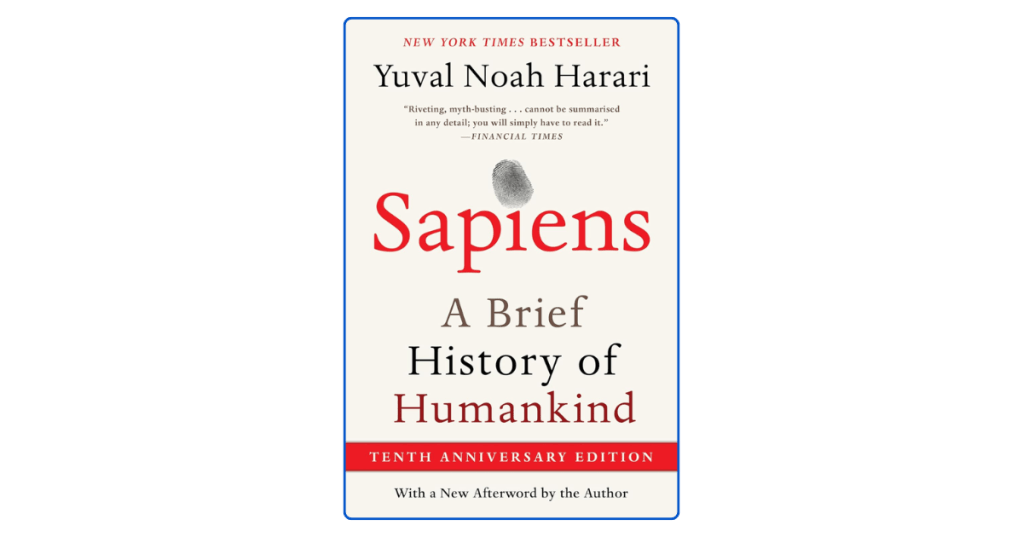
The Story of Us, From Survival to Supremacy
In Sapiens, historian Yuval Noah Harari delivers a sweeping exploration of human history from our humble beginnings as insignificant apes to our present-day dominance over the planet. With a masterful blend of anthropology, biology, and cultural analysis, Harari examines the forces that shaped our societies, beliefs, and economies.
This is not just a timeline of events it’s a provocative rethinking of how we got here, why we behave as we do, and where we might be headed. Harari challenges conventional narratives, revealing that much of what we take for granted religions, nations, money, and even human rights are shared myths we collectively agree to believe.
At its core, Sapiens is both humbling and unsettling: humbling in its reminder of our fragile evolutionary path, and unsettling in its questions about whether our so-called “progress” is truly making us happier.
Top 10 Lessons from Sapiens
1. Cognitive Revolution Was Our True Breakthrough
About 70,000 years ago, humans gained the ability to create and share complex ideas this skill allowed us to cooperate in large groups and outcompete other species.
2. Shared Myths Hold Societies Together
Concepts like religion, governments, and corporations exist only because people collectively agree they do. These imagined realities drive cooperation at scale.
3. Agriculture Was a Double-Edged Sword
Farming provided stability and population growth but also introduced inequality, hard labor, and new forms of suffering compared to hunter-gatherer life.
4. Empires Spread Ideas as Well as Power
While often oppressive, empires also unified diverse cultures, languages, and technologies, accelerating human development.
5. Money Is Humanity’s Universal Language
Unlike bartering, money allows trade between strangers and across cultures because it’s based on trust, not personal relationships.
6. Religion Shapes Morality and Order
Shared belief systems religious or secular moral codes and social rules, guiding behavior and maintaining stability.
7. Science and Capitalism Fuel Each Other
The modern world emerged from a partnership between scientific discovery and the capitalist drive for profit.
8. Happiness Isn’t Guaranteed by Progress
Technological and economic growth haven’t necessarily made humans more content; our brains are still wired for ancient survival challenges.
9. Humans Have Become a Planetary Force
From climate change to mass extinctions, human activity now shapes the Earth more than any natural process.
10. The Future May Redefine Humanity Itself
With genetic engineering, AI, and biotechnology, we may soon evolve beyond what we currently consider “human.”
Disclosure: This post includes affiliate links that may earn me a commission at no cost to you if you make a purchase.
can explore the book here:
Blinkist: Best Book Summaries & Audio Book Guide
Why This Book Matters Today
Sapiens is a powerful lens for understanding the past and questioning the future. It strips away romanticized history and shows that our greatest strength our ability to believe in shared fictions can be both a unifying force and a dangerous weapon.
Final Take:
“To know where we’re going, we must first understand the stories we’ve told ourselves to get here.”
![nick [Alliedify] Avatar](https://0.gravatar.com/avatar/6955a6009ff9c6a76e2eb88c263c9426c8c386b0a7637b4d0cc051871ee8c9f3?s=40&d=identicon&r=G)
 Alliedify
Leave a comment