How Successful Leaders Win Through Integrative Thinking
In The Opposable Mind, business strategist and former Rotman School dean Roger L. Martin presents a groundbreaking concept: the most successful leaders don’t choose between conflicting ideas they hold them both in tension to create a superior solution. This ability, which he calls integrative thinking, is what separates great decision makers from average ones in a world full of trade offs.
Drawing inspiration from leaders like Jack Welch, A.G. Lafley, and Michael Lee Chin, Martin shows how top performers resist binary thinking. Instead of settling for either/or choices, they construct innovative options that incorporate elements of both extremes. Like the opposable thumb which gives humans the unique ability to grip and manipulate the opposable mind allows leaders to grapple with complexity and emerge with breakthrough results.
Rather than promoting rigid frameworks, The Opposable Mind empowers readers to change how they think. It’s a masterclass in navigating ambiguity, designing creative strategies, and developing the cognitive flexibility required to lead in high-stakes environments.
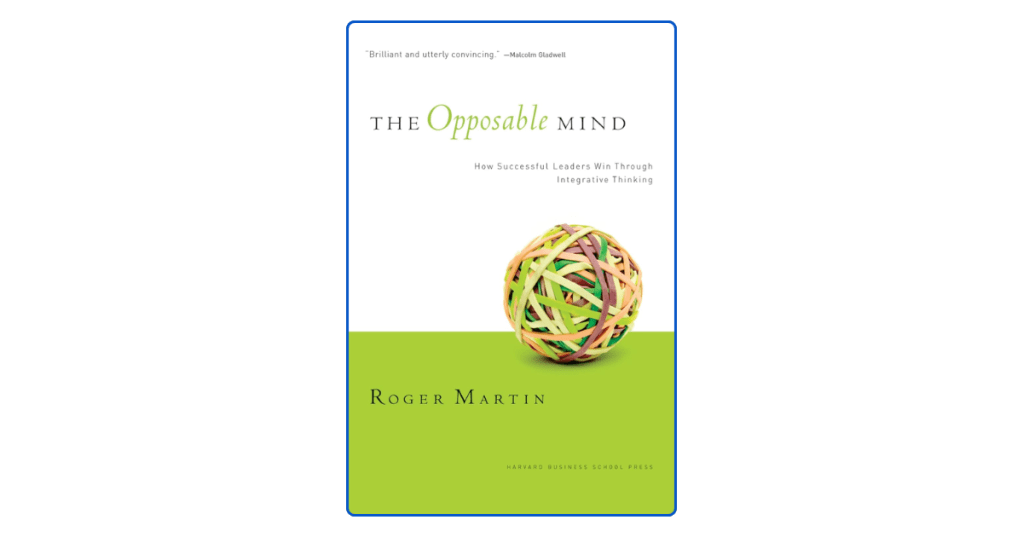
Top 10 Lessons from The Opposable Mind
1. Great Leaders Think Differently Literally
Top-performing leaders don’t just make different choices; they process problems differently. They embrace complexity instead of simplifying it prematurely.
2. Integrative Thinking Outperforms Either/Or Logic
Rather than choosing between two conflicting ideas, integrative thinkers creatively synthesize elements from both to craft a better solution altogether.
3. Tension Is a Catalyst for Innovation
Holding opposing ideas in tension creates the mental space for new insights. This discomfort is not a sign of indecision it’s a source of creativity.
4. Models Shape Choices But Can Be Redesigned
We all use mental models to interpret reality. Great thinkers recognize when their models are limiting them, and they aren’t afraid to build new ones.
5. Reject Trade Offs That Limit Possibility
Martin argues that we often accept false trade-offs. Instead of asking “Which option should I sacrifice?”, ask, “How can I achieve both?”
6. Seek Salience, Not Simplification
Leaders must weigh many factors and resist oversimplifying complex problems. Integrative thinkers prioritize what’s most relevant, not just what’s easiest to measure.
7. Causal Mapping Expands Strategic Insight
By understanding the deeper relationships between inputs and outcomes, integrative thinkers uncover leverage points others miss.
8. Personal Mastery Fuels Cognitive Agility
Developing the capacity for integrative thinking requires self-awareness, intellectual curiosity, and a willingness to examine one’s own biases and fears.
9. Confidence and Humility Must Coexist
To hold conflicting ideas without collapsing into indecision, leaders need the confidence to innovate and the humility to stay open to contradiction.
10. You Can Train Your Mind to Think This Way
Integrative thinking isn’t an innate talent it’s a learned capability. By challenging assumptions, expanding mental models, and practicing synthesis, anyone can improve their decision making.
Disclosure: This post includes affiliate links that may earn me a commission at no cost to you if you make a purchase.
can explore the book here:
Blinkist: Best Book Summaries & Audio Book Guides
![nick [Alliedify] Avatar](https://0.gravatar.com/avatar/6955a6009ff9c6a76e2eb88c263c9426c8c386b0a7637b4d0cc051871ee8c9f3?s=40&d=identicon&r=G)
 Alliedify
Leave a comment