Exposing the Dark Playbook Behind Global Economic Upheaval
How Crisis Became a Business Model
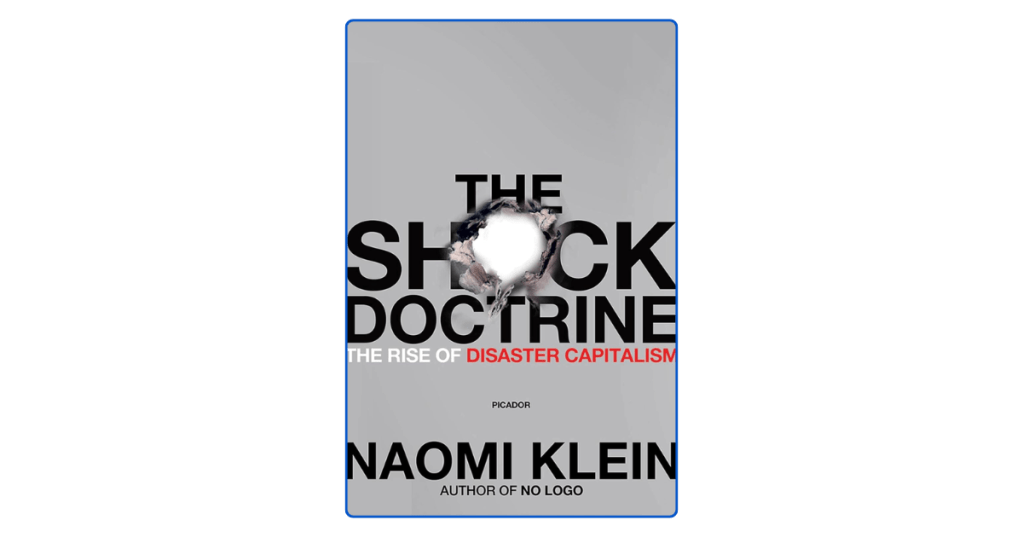
In The Shock Doctrine, investigative journalist and author Naomi Klein delivers a bold, disturbing thesis: some of the world’s most powerful economic and political actors have exploited natural disasters, wars, and crises to push through radical free-market policies that would otherwise face public resistance. This process what Klein dubs “disaster capitalism” is not accidental. It’s a calculated strategy rooted in economic shock therapy, designed to dismantle public institutions, privatize state assets, and concentrate wealth in the hands of a few.
Drawing on decades of global case studies from post-invasion Iraq to post-tsunami Sri Lanka, post-Katrina New Orleans to post-Soviet Russia Klein exposes how neoliberal policies are often imposed in moments of public disorientation. It’s not just about rebuilding after catastrophe it’s about rewriting the rules of entire societies while citizens are too distracted, displaced, or traumatized to fight back.
More than just a critique of economic theory, The Shock Doctrine is a compelling investigation into the politics of crisis, the weaponization of fear, and the high human cost of deregulated capitalism. It’s essential reading for anyone who wants to understand the deeper systems driving inequality, exploitation, and geopolitical control in the modern world.
Top 10 Lessons from The Shock Doctrine by Naomi Klein
1. Crisis Creates Opportunity for the Powerful
Disasters natural or man-made are often used by governments and corporations to implement sweeping changes under the radar. What’s billed as “recovery” often serves as a fast track for privatization and deregulation.
2. Economic Shock Therapy Breeds Instability
The rapid imposition of free-market reforms cutting public spending, lifting price controls, and selling off state assets frequently leads to social unrest, inequality, and long-term instability.
3. Privatization Is Not Always Progress
Many post-crisis “reforms” favor the private sector at the expense of public interest. Privatized education, healthcare, and infrastructure often deepen inequality rather than solve systemic problems.
4. Public Consent Is Circumvented During Chaos
When people are distracted by trauma, fear, or uncertainty, democratic debate is often sidelined. This opens the door for technocrats, think tanks, and elite interests to dictate policy.
5. Disaster Recovery Can Be a Profitable Business
Klein reveals how corporations and contractors often rush into disaster zones not to help, but to profit. The line between humanitarian aid and corporate opportunity is frequently blurred.
6. Military Force and Economic Policy Often Go Hand in Hand
In places like Iraq and Latin America, Klein shows how military intervention is used to enforce unpopular economic reforms highlighting the overlap between foreign policy and market ideology.
7. Neoliberalism Isn’t Neutral it’s Ideological
Free-market economics is often framed as common sense or inevitable, but Klein illustrates how it’s a deliberate ideology promoted by institutions like the IMF, World Bank, and Chicago School economists.
8. Trauma Weakens Resistance
When societies are in shock from war, natural disasters, or economic collapse citizens are less able to organize and resist. This vulnerability is often exploited by policymakers pushing radical reforms.
9. Globalization Amplifies Disaster Capitalism
In an interconnected world, multinational corporations can move quickly to seize assets, enter markets, and exploit labor in the wake of crises often with little local accountability.
10. Hope Comes from Informed Resistance
The book is ultimately a call to awareness and action. Understanding how disaster capitalism works is the first step toward resisting it through organizing, democratic engagement, and defending the commons.
Final Thought: Don’t Just Rebuild Reclaim
The Shock Doctrine isn’t just a warning it’s a blueprint for recognizing and resisting the manipulation of crisis for profit. Naomi Klein challenges readers to see beyond the headlines and question the deeper systems at play during moments of upheaval. In a time when climate disasters, political instability, and economic shocks are becoming more frequent, this book offers the historical context and critical lens we need to defend human rights, public assets, and democratic power.
Disclosure: This post includes affiliate links that may earn me a commission at no cost to you if you make a purchase.
can explore the book here:
Blinkist: Best Book Summaries & Audio Book Guides
![nick [Alliedify] Avatar](https://0.gravatar.com/avatar/6955a6009ff9c6a76e2eb88c263c9426c8c386b0a7637b4d0cc051871ee8c9f3?s=40&d=identicon&r=G)
 Alliedify
Leave a comment